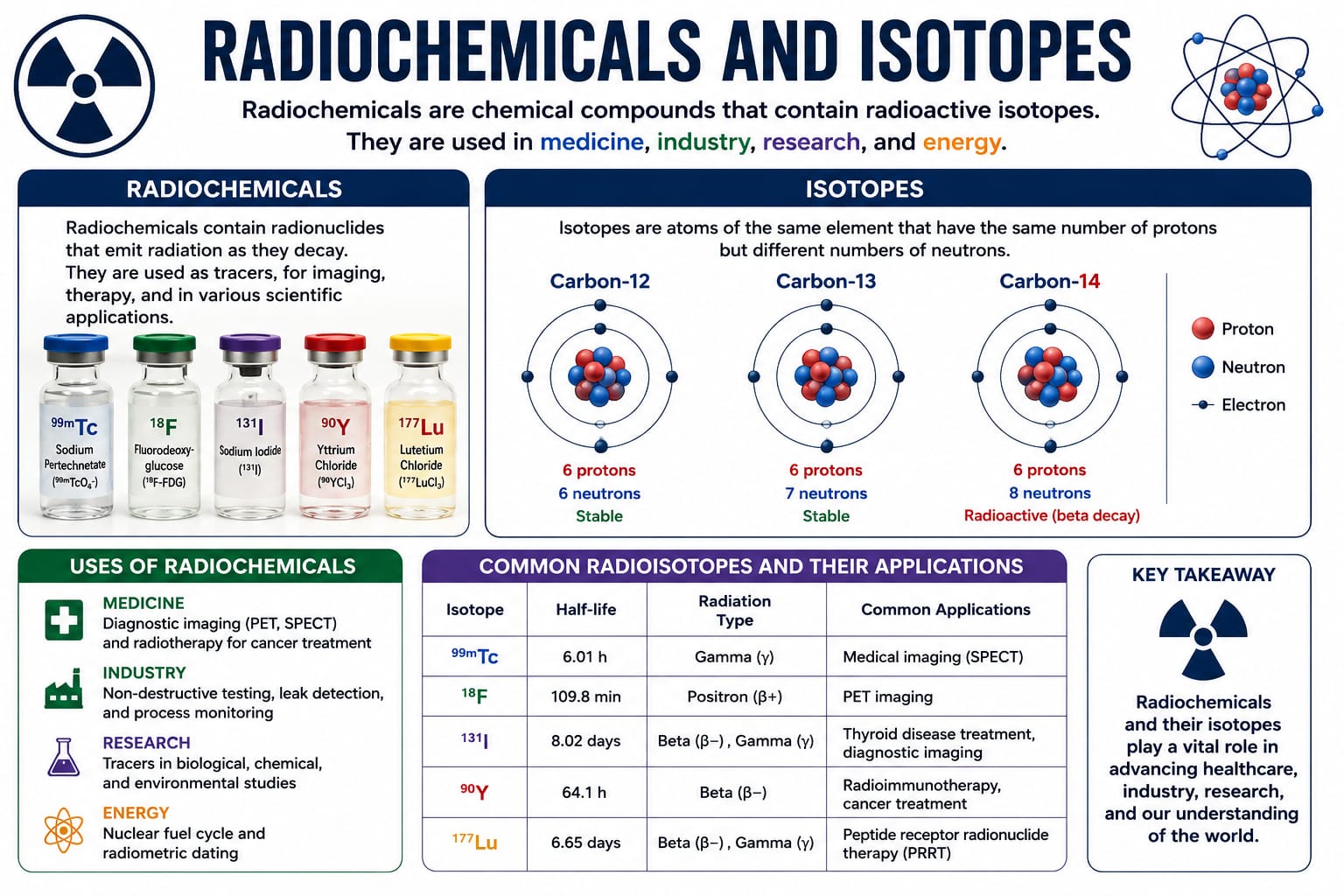
Radiochemicals & Isotopes
Radiochemicals are compounds containing radioactive isotopes, used in nuclear medicine, industrial tracing, environmental science, and archaeological dating. Technetium-99m alone is used in 50 million diagnostic scans annually worldwide, making it the workhorse of nuclear medicine. The fastest growing segment is targeted radionuclide therapy — using isotopes like Lutetium-177 and Actinium-225 to deliver radiation directly to cancer cells with minimal damage to healthy tissue. In 2026, the FDA approved the first actinium-225 based drug for metastatic prostate cancer, a landmark moment for the field and proof that radioisotope therapeutics are moving from research to clinical standard of care.
The science of radiochemicals hinges on understanding radiation-induced chemistry. When radioactive atoms decay, they release energy that can be harnessed for imaging (diagnostics) or therapy (treatment). Positron emission tomography (PET) uses fluorine-18 and other positron emitters to create high-resolution images of metabolic activity. Single photon emission computed tomography (SPECT) uses gamma-emitting isotopes like technetium-99m and indium-111. Targeted radionuclide therapy, conversely, exploits the chemical selectivity of radiochemical compounds — for example, a cancer-targeting antibody can be labeled with Lutetium-177, allowing the isotope to accumulate specifically in tumors where the radiation destroys cancer cells from within.
Beyond medicine, radiochemicals are critical to industry and environmental science. Radioactive tracers are used to study fluid flow in oil and gas operations, detect leaks in pipelines, sterilize medical devices, and perform nondestructive testing of materials. In environmental science, isotopic analysis reveals the age and origin of geological samples, water sources, and archaeological artifacts.
The IAEA coordinates global medical isotope supply security and publishes guidelines for radiopharmacy and transport — visit iaea.org/topics/nuclear-medicine. The US Isotope Programme at Oak Ridge manages production of over 300 isotopes and maintains the largest inventory of medical and research radioisotopes in the world — visit isotopes.gov. Paul Scherrer Institute in Switzerland leads European cyclotron-based isotope research, including novel Terbium-161 therapy development — visit psi.ch. The Society of Nuclear Medicine and Molecular Imaging publishes the leading peer-reviewed Journal of Nuclear Medicine and hosts the annual scientific assembly where radiochemistry research is presented — visit snmmi.org. Novartis is the commercial leader in radioligand therapy, marketing Lutetium-177 DOTATATE (Lutathera) for neuroendocrine tumors and Actinium-225 PSMA (Pluvicto) for prostate cancer — visit novartis.com. Russia's Russian Research Institute of Atomic Reactors (RIAR) operates six research reactors with one of the largest radiochemical production complexes in the world — visit niiar.ru. India's Board of Radiation and Isotope Technology (BRIT) produces medical isotopes and radiopharmaceuticals for domestic and international markets — visit brit.gov.in.
Radiochemistry deals with chemical systems involving radioactive isotopes, focusing on nuclear transformations, separation techniques, and application-specific synthesis.
Core Scientific Foundations
- Nuclear decay modes (alpha, beta, gamma)
- Radiochemical separation (solvent extraction, ion exchange)
- Isotope labeling and tracer kinetics
Advanced Research Areas
- Radiopharmaceutical synthesis (PET, SPECT imaging agents)
- Targeted alpha therapy (TAT) for cancer treatment
- Cyclotron and reactor-based isotope production
- Environmental radiotracing
Emerging Directions
- Personalized nuclear medicine using patient-specific isotopes
- Microfluidic radiochemistry for rapid synthesis
- Integration with nanotechnology for targeted delivery
Key Challenges
- Short half-life logistics (production to application timing)
- Radiation safety and regulatory compliance
- High infrastructure costs for isotope production